Pages · 1/7
The discount is still there — you just collect it somewhere else
From November 1, tax-free shopping in Japan no longer means a discount at the till. Visitors pay the full tax-included price, and get the tax back once customs confirms at departure that the goods are leaving Japan. The dividing line is the purchase date: anything bought on or before October 31 still uses the old system.
Nov 1
2026 · Refund method begins (National Tax Agency)
¥5,000
Minimum purchase per store per day, excluding tax
Pages · 2/7
Read one bill first: which money comes back
A ¥50,000 item (excluding tax) costs ¥55,000 including tax. From November 1, you pay ¥55,000 in store, and the amount that can come back at departure is ¥5,000 — about 9.1% of what you paid, not 10%.
Pages · 3/7
Three traps, starting with the harshest
First, one receipt stands or falls together: if any item on it is missing at customs confirmation, the whole receipt gets nothing. Second, customs confirmation must come before check-in — after bags are checked, it cannot be done. Third, food and cosmetics used inside Japan lose their refund.
90 days
Customs confirmation window from purchase (National Tax Agency)
Pre-check-in
Customs confirmation deadline — no remedy after bags are checked
Pages · 4/7
What got simpler
The category split is gone: general goods and consumables are no longer counted separately, so a single store's daily total of ¥5,000 excluding tax is enough. The ¥500,000 cap on consumables is abolished, and so is the sealed-packaging requirement. The confirmation window is now 90 days for everything, up from 30 days for consumables.
Abolished
¥500,000 consumables cap (National Tax Agency)
Abolished
Sealed-packaging requirement (National Tax Agency)
Pages · 5/7
On departure day, in this order
First, the tax-free procedure terminal in the departure lobby, before the check-in counters. Scan your passport. GREEN: confirmation complete. RED: take all your goods to the inspection area — an inspection, not a refusal. At seven major airports — Narita, Haneda, Kansai, Chubu, New Chitose, Fukuoka, Naha — Visit Japan Web also works over the departure lobby's dedicated Wi-Fi. Check your bags only after confirmation.
Passport
Needed in store and at the airport
All goods
Bring them with you — do not check them first
Pages · 6/7
The judgment card
The new system does not filter out people who buy little. It filters out people who cannot finish the procedure. If the goods leave Japan complete and the procedure is done before check-in, every yen of tax comes back; if it is not done, the tax stays in Japan.
About 9.1%
Refund as a share of a ¥55,000 bill actually paid (worked example)
Watch the first quarter under the new system: do small, scattered tax-free purchases fall, and does the refund completion rate catch up? If neither falls, this article's "the procedure filters people" judgment is wrong.
Pages · 7/7
From November 1, Japan's tax-free shopping changes from "cheaper at the till" to "refunded at departure" — the tax is still refunded in full, but only to people who take the goods out of Japan complete and finish customs confirmation before check-in. So the new way to shop is not to pile up purchases, but to make sure every receipt can be shown complete.
From November 1, 2026, Japan's tax-free shopping becomes a refund: pay the tax-included price, get it back after customs confirms the goods leave Japan. October 31 purchases keep the old system. The ¥5,000 threshold stays, but a receipt stands or falls whole, and customs comes before check-in.
Key takeaways
- From November 1, 2026, Japan's tax-free shopping becomes a refund: pay the tax-included price in store, then get the tax back after customs confirms the goods leave Japan (National Tax Agency).
- The dividing line is the purchase date, not the departure date: purchases on or before October 31, 2026 use the old system; purchases from November 1 use the refund method (Japan Customs).
- Eligibility turns on non-resident status, not nationality: people who live in Japan — of any nationality — cannot use the system; Japanese nationals who have lived abroad for two years or more and are visiting temporarily can, with proof of residence abroad (National Tax Agency).
- The threshold is unchanged: ¥5,000 or more excluding tax, per store per day, no longer split between general goods and consumables (National Tax Agency).
- Three things are abolished: the ¥500,000 consumables cap, the sealed-packaging requirement, and the daily-use determination; the confirmation window is 90 days from purchase (National Tax Agency).
- One receipt stands or falls together: if any item in the same purchase record is missing at customs confirmation, the whole receipt gets no confirmation (National Tax Agency, Japan Tourism Agency).
- The airport flow: scan your passport at a tax-free procedure terminal in the departure lobby — GREEN completes the confirmation, RED means take all your goods to the inspection area. Visit Japan Web works at Narita, Haneda, Kansai, Chubu, New Chitose, Fukuoka and Naha (dedicated Wi-Fi in the departure lobby). If you connect from a domestic flight, do the procedure at your final departure airport (Japan Customs).
- Customs confirmation must be completed before checked baggage is handed over; after check-in it cannot be done, and checked baggage cannot be retrieved. Goods confirmed by customs must be exported without delay, or the tax is collected and a penalty may apply (Japan Tourism Agency, Japan Customs).
- The refund is paid after customs confirmation by the tax-free shop or its refund service provider, using the method registered at purchase (bank transfer, credit card, app, or cash at the port of departure). The consumption tax law sets no uniform refund method, fee or timing (National Tax Agency).
- Worked example: a ¥50,000 item (excluding tax) costs ¥55,000 including tax; the refund is ¥5,000, about 9.1% of the amount actually paid.
- Excluded: gold and platinum bullion and coins, and goods already exempt from consumption tax (National Tax Agency).
From November 1, Japan's tax-free shopping changes from "cheaper at the till" to "refunded at departure" — the tax is still refunded in full, but only to people who take the goods out of Japan complete and finish customs confirmation before check-in. So the new way to shop is not to pile up purchases, but to make sure every receipt can be shown complete.
First, the cast: who is who in this article
The visitor (short-term visitor) — the person shopping with a passport at a tax-free shop. Under the new system, the visitor pays the tax first and gets it back at departure; if the procedure is not finished, the tax paid in advance does not come back.
The tax-free shop — a shop displaying the "Japan Tax-Free Shop" sign. Under the old system it took the tax off at the till; under the new system it sells at the tax-included price, and after customs confirmation it (or its refund service provider) returns the tax to the visitor.
Customs — responsible for exactly one thing: confirming that the goods are really leaving Japan. Customs does not pay the money; the shop pays it. If customs cannot confirm, the shop cannot refund.
The refund service provider — some tax-free shops outsource the refund procedure to a specialist company. The refund method, timing and any fee are set by the shop or this provider, not uniformly by customs.
How the money flows — the visitor pays the tax-included price in store → at departure, customs confirms the goods are exported → the tax-free shop refunds the consumption-tax amount to the visitor. Under the old system the tax was removed at step one; under the new system it is returned at the last step. The destination of the money is the same — the extra step is proving the goods left Japan.
1. The new system in one minute: start with the purchase date
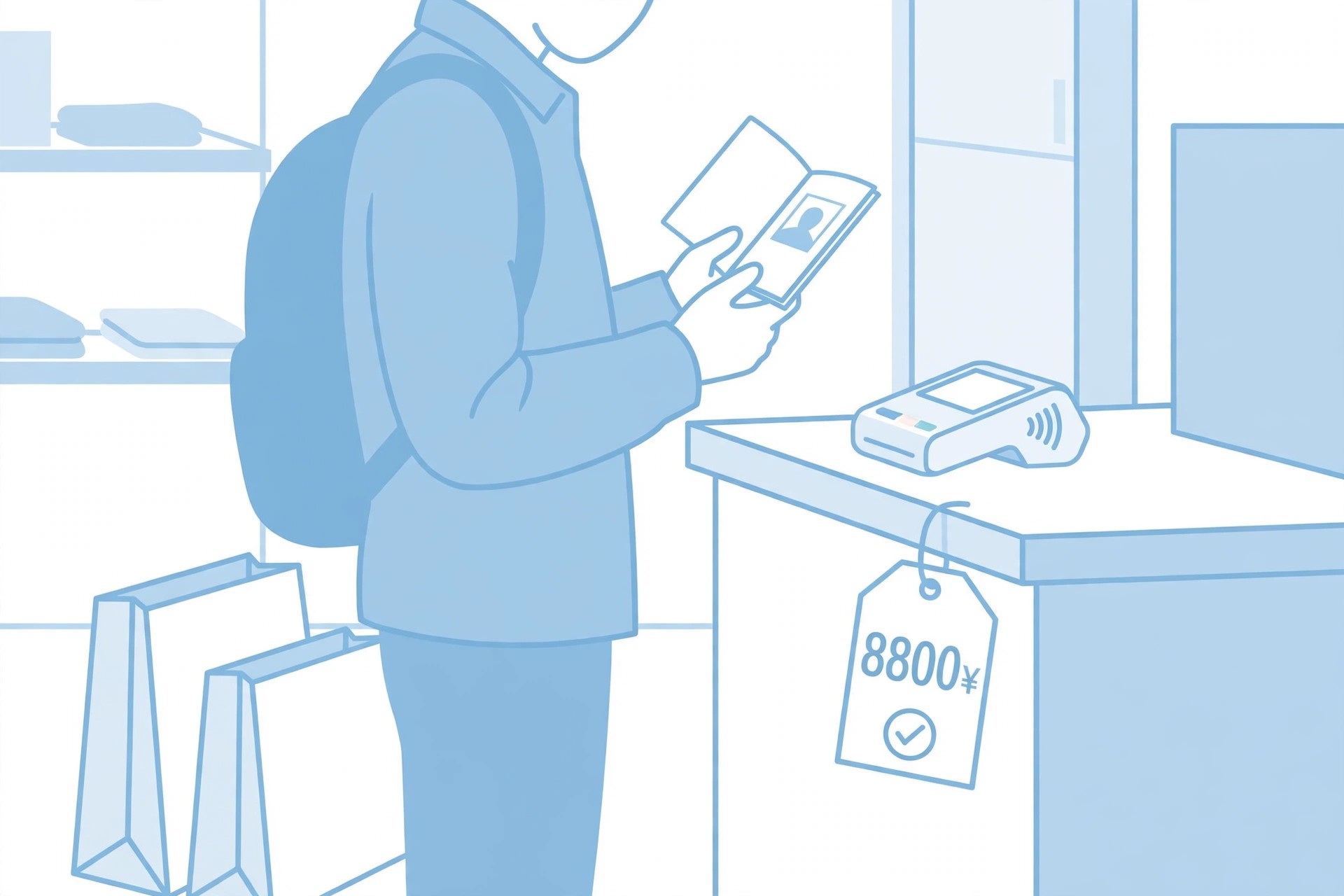
There is one dividing line, and it is the purchase date — not the departure date. Goods bought on or before October 31, 2026 use the old system: the tax comes off at the till. Goods bought on or after November 1 use the new one: pay the tax-included price in store, have customs confirm at departure that the goods are leaving Japan, and the shop refunds the tax after that confirmation. If you bought in late October and fly out in November, your shopping is under the old system — no new procedure applies to it.
| Old system (purchases up to October 31, 2026) | New system (purchases from November 1, 2026) | |
|---|---|---|
| What you pay in store | Tax-excluded price — the tax comes off at the till | The tax-included price, in full |
| Customs confirmation | The procedure essentially ended in the store | Everyone does it at departure: scan your passport at a terminal; GREEN completes it, RED means an inspection of the goods |
| When you get the tax | You never paid it | After customs confirmation, refunded by the shop or its refund provider |
| Consumables packaging | Sealed packaging; must not be opened or used in Japan | Sealed packaging abolished; but anything consumed in Japan still loses its refund |
| How the amount is counted | ¥5,000 or more excluding tax per store per day; consumables had a separate ¥500,000 cap | ¥5,000 or more excluding tax per store per day, all goods together, no cap |
| Departure deadline | 30 days for consumables | 90 days from purchase, for everything |
Pay
The full tax-included price at the tax-free shop; register how the refund will reach you
Customs
Before check-in, scan your passport at a terminal — GREEN completes it, RED means an inspection
Refund
Paid by the shop or its refund provider after confirmation, using the method you registered
One common arithmetic mistake, cleared up first: a tax-included price of ¥11,000 contains ¥1,000 of consumption tax — that ¥1,000 is the refund. It is about 9.1% of the tax-included price, not "10% off the whole bill." (This example ignores any service fee; the actual refund follows the rules of the shop and its refund provider.)
What this chart shows: the refund is the consumption tax itself. In a ¥55,000 bill, ¥50,000 is the goods and ¥5,000 is the tax; the amount that can come back is ¥5,000. Why change at all? The government's stated reason is to prevent tax-free goods from being resold inside Japan. Under the old system the tax was removed in the store, and whether the goods really left Japan could only be checked afterwards; under the new system the tax is held first and refunded only when export is confirmed — resellers cannot collect the refund, so the loophole closes at the source.
Fact
National Tax Agency, "FY2025 Tax Reform" tax-free revision note (June 2025 edition): from November 1, 2026, the system shifts to the refund method. Four changes: tax-free shops sell at tax-included prices; purchasers must receive customs confirmation of export within 90 days of purchase (counted from the day after purchase to the 90th day — the agency's example: a November 1 purchase must be confirmed by January 30 of the following year); shops qualify for exemption by preserving purchase-record and customs-confirmation information; and after confirmation, shops refund the consumption-tax amount to purchasers.
2. Who can get a refund: status, not nationality
Tax-free shopping is for non-residents. The test is whether you have an address in Japan and live your life here — not which passport you hold.
- Short-term foreign visitors can. Tourists who entered Japan for a short stay just show their passport when shopping.
- People who live in Japan cannot — whatever their nationality. Anyone with an address in Japan and a life based here, including foreign nationals working or studying in Japan on a residence card, is a resident, not a non-resident, and is outside this system.
- Japanese nationals who live abroad can. If you have lived outside Japan continuously for two years or more and are visiting temporarily, you need, in addition to your passport, a document proving residence abroad: a certificate of residence or a copy of the family register attachment (koseki no fuhyō) — an Individual Number Card (My Number Card) is now also accepted. The document must have been issued within six months before your most recent entry into Japan.
- Quantities are limited to what you can carry out yourself. And gold and platinum bullion and coins, and goods already exempt from consumption tax, are outside the system.
3. What to do when you shop
- Look for the sign, and bring your passport. Shop at stores displaying the "Japan Tax-Free Shop" sign. Your purchase record is registered against your passport — if the passport details are recorded wrong, the confirmation later will jam.
- Pay the tax-included price, and register how the refund will reach you. The refund method is registered at purchase. Which methods exist, whether there is a fee, and how long it takes all differ by shop and refund provider — ask those three questions at the till, and keep the receipt and the refund instructions.
- The threshold is a combined total. ¥5,000 or more excluding tax, in one store on one day, all goods counted together — no more splitting general goods and consumables.
- For a single item of ¥1 million or more, keep the paperwork. For items priced at ¥1 million or more excluding tax, the shop must record identifying details in the purchase record — brand, model, colour, serial number. At a customs inspection you may be asked to show a certificate of authenticity or warranty together with the item. Collect those documents when you buy, and carry them with you at departure.
- Manage your bags by receipt. Everything on one receipt stays unopened, unused and together until departure — the next section explains why.
4. Six ways a refund is lost
Fact
National Tax Agency revision note, section 2, note, and the Japan Tourism Agency's traveler guidance: customs confirmation is conducted per purchase transaction (one receipt). If, at confirmation, the purchaser does not possess even one of the tax-free goods in a purchase record, none of the goods in that record can receive confirmation. Confirmation is all or nothing per receipt.
- Checking bags before confirming. Reverse the order and the refund is gone: after baggage is checked in, customs confirmation cannot be completed — and checked baggage cannot be retrieved to fix it. Prevention: confirm first, check in second, and arrive with time to spare.
- One item missing from a receipt. A packet of snacks eaten, a bottle of cosmetics opened and used, one item already packed into a checked suitcase — if anything on the receipt is missing, the whole receipt loses its refund. Prevention: keep everything on a receipt together and untouched until customs confirmation is done.
- Consuming things inside Japan. Food, drinks and cosmetics consumed in Japan lose their eligibility. The sealed bag is gone; the rule is not. If you have already consumed something, the official instruction is: do not run the procedure at a terminal — report the consumption to a customs officer at the counter. Prevention: buy things you plan to use during the trip separately, at the tax-included price, outside the tax-free receipt.
- Passing the 90-day window. If customs confirmation is not completed within 90 days of purchase, the eligibility is gone. Prevention: on long or multi-leg trips, count the days first — goods bought on November 1 must be confirmed by January 30.
- Walking away from a RED result. A red result only means an inspection is required; it is not a refusal. But if you abandon the inspection because your flight is boarding, officials treat the confirmation as not completed — and neither customs nor the airline compensates you for time lost to the procedure. Prevention: the passport scan itself takes seconds; the queue for an inspection is what needs the time margin.
- Passport or registration errors. If the passport details in the purchase record are wrong, or the refund method was registered wrongly, confirmation and payment both jam. Prevention: check the passport number and refund method at the till, and correct them on the spot.
5. What got simpler: three abolitions and 90 days
The new system does not only add a procedure — it removes three old ones.
Fact
National Tax Agency revision note: abolished together with the shift to the refund method are the category distinction between general and consumable products, the ¥500,000 maximum purchase amount for consumables, special packaging (sealed bags), and the determination of whether goods are for daily use. The ¥5,000 minimum is now calculated without categories, on the price excluding tax. The Japan Tourism Agency's official note: the export window is extended from 30 days to 90 days.
For visitors, the practical gains are three. First, reaching the threshold is easier: food and daily goods used to need their own ¥5,000 total and could not exceed ¥500,000; now all goods in one store count together toward ¥5,000, with no cap. Second, no more nursing sealed bags through a trip: the bags are abolished, though the goods themselves still must not be used in Japan. Third, more time: consumables used to need export within 30 days; now everything has 90 days — something bought on November 1 can be confirmed as late as January 30, so long multi-stop trips no longer need to rush.
One more point worth knowing: if a tax-free shop ships goods directly overseas (the direct-shipping system), that follows a separate export-exemption route rather than the refund procedure. The old method of mailing tax-free goods out yourself was abolished; whether a shop will ship for you is up to the shop — ask before you buy.
6. Departure day, in this order
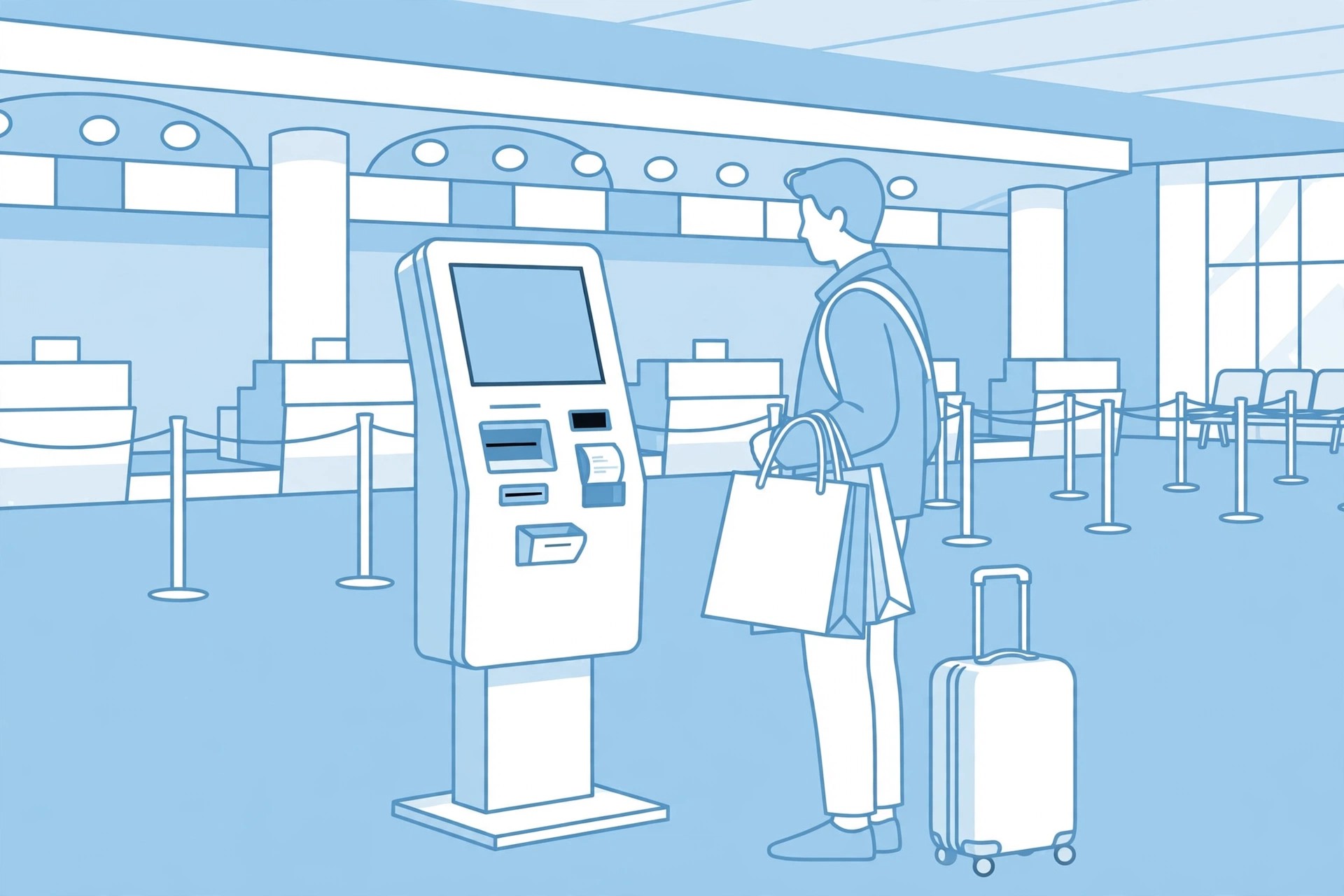
On departure day, the order decides whether the refund is received:
- Do not check bags yet. The tax-free procedure terminals stand in the international departure lobby, before the check-in counters. Bring your passport and all your tax-free goods, and scan the passport — from the scan to the result takes only a few seconds.
- Read the result: GREEN is done, RED is an inspection. A green result means the customs confirmation is complete. A red result means take all your goods to the designated customs inspection area and show them — red is a spot-check of the goods, not a refusal of your refund.
- Seven major airports also work online. At Narita, Haneda, Kansai, Chubu, New Chitose, Fukuoka and Naha, you can complete the procedure with Visit Japan Web by connecting to the dedicated procedure Wi-Fi in the international departure lobby (before security) — set up Visit Japan Web in advance. If you cannot use it, use a terminal instead. Note that completing the procedure online does not exempt you from a physical inspection if one is required.
- Connecting from a domestic flight? Confirm at your final departure airport. The procedure is done at the airport from which you actually leave Japan. For each airport's terminal and inspection-area locations, see Japan Customs' official map page (linked in the sources).
- Check in only after confirmation. Once confirmation is complete, proceed to baggage check-in and boarding.
- The money moves only after confirmation — in four steps. Customs confirmation completed → the tax-free sale is established → the shop or its refund service provider executes the refund → you actually receive it. Customs does not pay the money. The refund uses the method registered at purchase: bank transfer, credit card transfer, an app-based refund, or cash at the port of departure — as set by the shop. There is no official uniform fee or number of days: the National Tax Agency states plainly that the consumption tax law does not prescribe how refunds are carried out. Claims of a "uniform 3% fee" or "everyone is paid in 7 days" have no official basis — what counts is the explanation given by the shop where you bought.
One more baseline: goods confirmed by customs must be exported without delay. Japan Customs' notice states that if confirmed goods are not exported, the consumption-tax amount equivalent to the exemption is collected and a penalty may apply. Confirmation is not a voucher to keep for next time.
7. The counter-argument: for whom is the new system actually easier
In fairness to the new system, it does reduce the burden on tax-free shops: no more judging whether each item is for "daily use," no more sealed bags and packaging materials, fewer procedures at the till. For compliant visitors it also has real gains: no category split when reaching the threshold, no ¥500,000 cap, a 90-day window instead of 30 — people who buy a lot and travel long actually come out better than under the old system.
Our reading
So the "the procedure filters people" judgment needs a qualifier: it filters out people who cannot finish the procedure, not people who buy little. The ¥5,000 threshold has not changed and the tax amount has not changed; what changed is who performs the "prove export" step, and at which step. The old system put the proof in the store; the new system puts it at the airport — most expensive for people with tight schedules, heavy luggage and purchases scattered across many shops, and almost free for people with time to spare, concentrated shopping and half an hour before departure.
The government's motive should also be stated in full: preventing resale is the real motive, but it is not the only ledger entry. Centralizing confirmation at customs also frees tax-free shops from responsibility for judging each purchase's compliance, so shops no longer underwrite every transaction's legality. That is the other half of why the reform can go ahead — the procedure's cost moved from shops to visitors' departure flow, while shops saved the packaging and judgment costs.
8. Our judgment: shop by receipt, not by total
Our reading
The old way to shop was "reach the threshold": ¥5,000 in one store, one day, one category. The new way is "count the receipts": can every receipt be shown complete at departure? Are all its items in hand, unused in Japan, and producible before check-in? A receipt that passes that test is worth opening; one that does not is better merged into a receipt that can be shown complete — or simply bought at the tax-included price. Buying at the tax-included price costs nothing extra; the loss only happens when a refund is expected and then fails.
The falsification condition is stated up front: if, once the new system is running, the share of visitors actually receiving refunds matches the completion rate of tax-free transactions under the old system, and small scattered tax-free purchases do not fall, this article's "the procedure filters people" judgment is wrong. Watch the first quarter's operating reports and the Japan Tourism Agency's survey: whichever moves first — small purchases falling, or refund completion catching up — is the answer.
9. Frequently asked questions
Q: I bought before November 1 but leave Japan after November 1. Which system applies? A: The purchase date decides. Purchases on or before October 31, 2026 use the old system — the tax already came off at the till, and no new procedure applies. Only purchases from November 1 onward use the refund method.
Q: How much do I have to spend to get a refund? A: ¥5,000 or more excluding tax, at one tax-free shop on one day, all goods counted together.
Q: I am a foreign national living in Japan. Can I get a refund? A: No. The system is for non-residents. Anyone whose address and life are based in Japan — of any nationality — is outside it. Conversely, a Japanese national who has lived abroad continuously for two years or more and is visiting temporarily can use it, with proof of residence abroad.
Q: Can I use the cosmetics I bought at a drugstore while I am in Japan? A: If you do, the refund is lost. Sealed packaging has been abolished, but consumables consumed in Japan are not eligible. If you have already consumed something, do not run the procedure at a terminal — report it to a customs officer at the counter.
Q: The packaging is opened but the item is unused. Can I still get the refund? A: According to the Japan Tourism Agency, confirmation turns on two things: whether the goods are in your possession, and whether they have been consumed. Opening the packaging is not among the disqualifying cases the official guidance lists. If you are unsure, explain the situation at the inspection area rather than giving up the whole receipt on your own.
Q: I forgot the procedure at the airport, or I had already checked my bags. Can I fix it afterwards? A: No. Confirmation must be completed at departure, before check-in; the official procedure has no retroactive fix, and checked baggage cannot be retrieved.
Q: Can the refund go straight to my bank card? A: It can be one of the options. The methods the official guidance lists include bank transfer, credit card transfer, app-based refunds and cash at the port of departure; which one applies is set by the shop and registered when you buy.
Q: How long until I receive the refund? A: The official answer: after customs confirmation establishes the tax-free sale, the shop generally begins processing the refund. There is no uniform number of days — it depends on the shop and its refund provider, so go by the explanation given at purchase.
Q: I am buying a watch priced over ¥1 million. Anything extra to prepare? A: The shop records identifying details — brand, model, serial number — in the purchase record, and customs may ask you to present a certificate of authenticity or warranty together with the item. Keep those documents from the purchase, and carry them at departure.
Q: My departure airport has no Visit Japan Web tax-free procedure. What do I do? A: Online confirmation via Visit Japan Web is available only in the departure lobbies of seven airports — Narita, Haneda, Kansai, Chubu, New Chitose, Fukuoka and Naha — over the dedicated Wi-Fi. Everywhere else, and whenever Visit Japan Web is unavailable, use a tax-free procedure terminal in the departure lobby; the procedure and the result are the same.
Sources & references
- National Tax Agency, "FY2025 Tax Reform" tax-free revision note (June 2025 edition, English): shift to the refund method from November 1, 2026; the purchase-date dividing line; 90-day confirmation window; ¥5,000 threshold; how purchaser eligibility is confirmed (non-residents; documents for Japanese nationals resident abroad for two years or more); purchase-record identifying details for items priced at ¥1 million or more; no statutory uniform refund procedure; abolished items and exclusions; all-or-nothing per receipt; direct-shipping system https://www.nta.go.jp/publication/pamph/shohi/menzei/202506/pdf/0025006-106.pdf
- Japan Customs, "Tax Exemption (Refund) Program for Foreign Visitors": purchases up to October 31, 2026 under the old system; passport presentation at a terminal within 90 days; a GREEN result completes confirmation, a RED result sends you to the designated inspection area; Visit Japan Web online procedures at seven airports over the dedicated Wi-Fi in the departure lobby https://www.customs.go.jp/kaigairyoko/taxrefund.htm
- Japan Customs, "Customs Procedure Details": the three steps — buy at the tax-included price, customs confirmation at departure, refund by the tax-free store using the registered refund method; procedures completed at the airport or seaport of final departure https://www.customs.go.jp/kaigairyoko/taxrefund/C-details.html
- Japan Customs, "Airport and Seaport Maps": locations of tax-free procedure terminals and customs inspection areas at each airport and seaport https://www.customs.go.jp/kaigairyoko/taxrefund/map.htm
- Japan Tourism Agency, "Information on the New Tax-Free Shopping System (Refund Method)": terminals and inspection areas are in the departure lobby before baggage check-in; confirmation must be completed before boarding procedures; abandoning an inspection counts as not completed; domestic-to-international connections confirm at the final departure airport; confirmation is per receipt; consumption of goods is reported to a customs officer; confirmed goods must be exported without delay https://www.mlit.go.jp/kankocho/tax-free/page01_000001_00028.html
- Japan Tourism Agency, "Frequently Asked Questions for Travelers (Refund Method)": the terminal scan takes a few seconds; checked baggage cannot be retrieved; how consumed consumables are handled; items priced at ¥1 million or more may require a certificate of authenticity or warranty at inspection; refund methods (bank transfer, credit card, app, cash at the port of departure) and refund timing https://www.mlit.go.jp/kankocho/tax-free/page01_000001_00027.html
- National Tax Agency and Japan Customs, "Notice to Foreign Travelers Who Purchase Tax-Free Goods" (English): confirmation must precede check-in, goods must be producible, confirmed goods must be exported without delay or tax is collected https://www.nta.go.jp/publication/pamph/shohi/menzei/201805/pdf/caution_en.pdf
- Japan Tourism Agency, "Inbound Consumption Trend Survey 2025 Annual Report": 2025 visitor shopping consumption about ¥2.51 trillion, per-visitor shopping ¥61,136, shopping share of consumption 34.7% in 2019 → about 27% in 2025 (re-checked from this site's existing audit)
Spotted an error or something out of date? Let us know via the contact page. Corrections are reflected in the updated date.
Original research and analysis by JNoted. Please cite with a link; full republication or commercial use requires prior permission.