Pages · 1/7
Two shortages, not one
One can be filled; the other cannot. The half of matcha that can be mass-produced is up about 3.2 times in a decade. The half that cannot be expanded is fixed in place by acreage, season and certification. Mixing the two up is the most common misreading of this boom.
Pages · 2/7
What the world is scrambling for
In 2025 export volume rose 43% and the unit price 38% — half the doubling was quantity, half was price. Powdered tea is 84% of export value, and the United States alone takes 41% of the money.
Pages · 3/7
Supply is not asleep
Tencha output is up about 3.2 times in a decade. The largest producing prefecture is not Kyoto but Kagoshima — mechanisation and a shift of production south are lifting the total.
Pages · 4/7
The expensive one is a different product
Under one name, the top grade trades at 5 times the tencha average and 25 times sencha. It is picked once a year, after weeks under shade, by hand — its price is a ceiling on physical capacity, not a marketing premium.
Pages · 5/7
Why the pool cannot widen
−23%
Tea acreage in a decade
~4 yrs
From planting to first picking
63%
Of US/EU-bound exports under organic arrangements
The fields allowed into the high-price pool are far fewer than total tencha suggests.
Pages · 6/7
What to watch
Watch the 2027 first-flush auctions. If hand-picked Uji tencha falls back toward 2024 prices while volumes rise, the high-price pool can widen after all, and this article is wrong. Until then, watch volumes before prices.
Pages · 7/7
There are two matcha shortages. Powdered tea that can be scaled has tripled in a decade and is catching up with demand. What is genuinely scarce is the small pool of shaded first-flush leaf — locked by acreage, by the harvest calendar and by organic certification, it cannot expand no matter how high the price goes.
Japan's green-tea exports doubled in a year to ¥72.1 billion in 2025, powdered tea at 84% of value. Yet tencha output has tripled in a decade — the scalable half is not short. What is short is shaded first-flush leaf: hand-picked Uji tencha hit ¥43,330/kg while tea acreage shrank 23% in a decade.
Key takeaways
- Green-tea exports doubled in a year to ¥72.1 billion in 2025: volume +43%, unit price +38%. Half the boom is real demand; half is price.
- Powdered tea (matcha together with powdered sencha and similar, in the trade statistics) is 84% of export value; the US is the largest buyer at 41% of value.
- Tencha production has risen about 3.2 times in a decade, led by Kagoshima, not Kyoto — the total supply of "matcha" is not short.
- What is short is shaded first-flush leaf: hand-picked Uji tencha at ¥43,330/kg, 5 times the national tencha average and 25 times sencha.
- Acreage is down 23% in a decade, a new bush needs about four years to first picking, and about 63% of US/EU-bound exports are organic-certified — the high-price pool is structurally locked.
There are two matcha shortages. Powdered tea that can be scaled has tripled in a decade and is catching up with demand. What is genuinely scarce is the small pool of shaded first-flush leaf — locked by acreage, by the harvest calendar and by organic certification, it cannot expand no matter how high the price goes.
First, separate them: there are two markets
Food-grade powder — the powder in lattes, ice cream, baking and bottled drinks. Centred on Kagoshima, machine-picked, second-flush leaf usable, expandable through factories and field conversion. Japan's average export unit price for powdered green tea in 2025 was ¥6,927 a kilogram.
Ceremonial-grade tencha — the raw material of top matcha for the tea ceremony. Shaded first-flush leaf from places like Uji, hand-picked, stone-milled. Hand-picked Uji tencha cost ¥43,330 a kilogram in 2025. Its constraint is not the factory. It is the field.
One problem is solved in a factory. The other is solved, if at all, in a field. The numbers below belong to one market or the other.
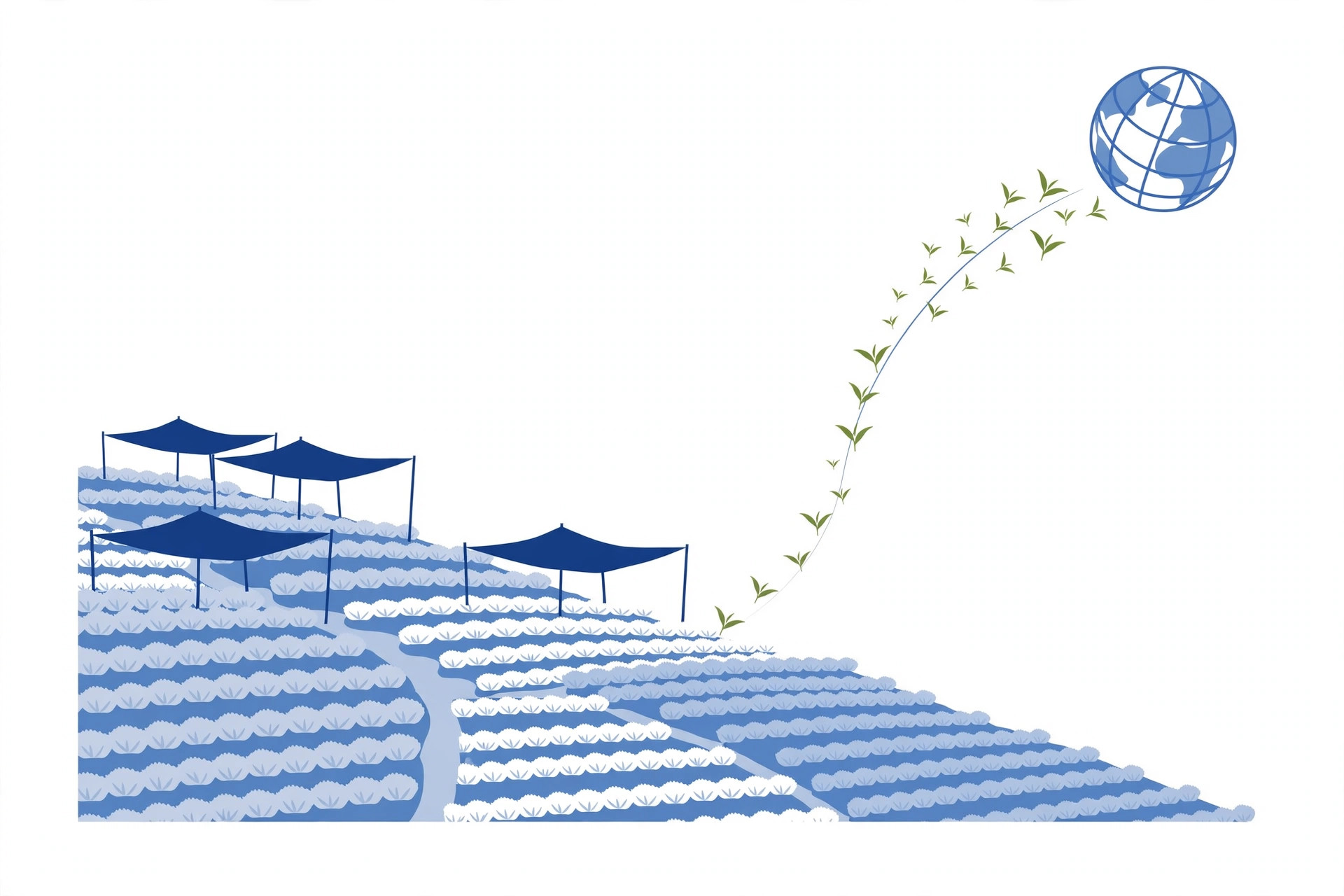
The consensus: the world is scrambling for matcha — and it is right, so far
A scope note first: trade statistics have no line called "matcha." What follows uses the Ministry of Finance's "green tea" (HS 0902), within which "powdered" is the closest category to matcha — but it also includes powdered sencha and similar products, not matcha alone.
What this chart shows: export value rose roughly fivefold in six years and doubled in 2025 alone — volume up 43%, unit price up 38%. Quantity and price rose together.
Fact
The Ministry of Agriculture's October 2026 tea review, compiling Ministry of Finance trade statistics: 2025 green-tea exports were ¥72.1 billion and 12,612 tonnes. Powdered tea was 8,718 tonnes — 69% of volume and 84% of value. The United States was the largest destination at 41% of value, and 85% of US-bound tea was powdered. Exports in January–August 2026 reached ¥67.4 billion, still above the same period a year earlier.
The demand is real, and so is the money. What the consensus leaves out comes next.
But supply is not asleep: tencha output has tripled
What this chart shows: on totals alone, "Japan cannot produce matcha" is wrong — tencha output is up about 3.2 times in a decade and was 8.6% of national crude-tea production in 2025.
Fact
National tea producers' federation figures, published by the agriculture ministry: tencha production was 5,336 tonnes in 2024 and about 6,278 tonnes in 2025 — roughly 3.2 times the 2014 level. Kagoshima is the largest producing prefecture, then Kyoto and Shizuoka. The state subsidises conversion: ¥100,000 per 10 ares for shading materials to switch fields to tencha, ¥152,000 per 10 ares for replanting.
The growth comes from mechanised regions and from conversion: sencha fields turned to tencha, second-flush leaf made into food-processing tencha. On the volume side, the price signal works.
What is actually short is a different matcha
What this chart shows: under one word, "tea," prices span a 25-fold range. There is no single "price of matcha" — there is a long gradient from drink ingredient to ceremonial good, and the shortage lives only at its top.
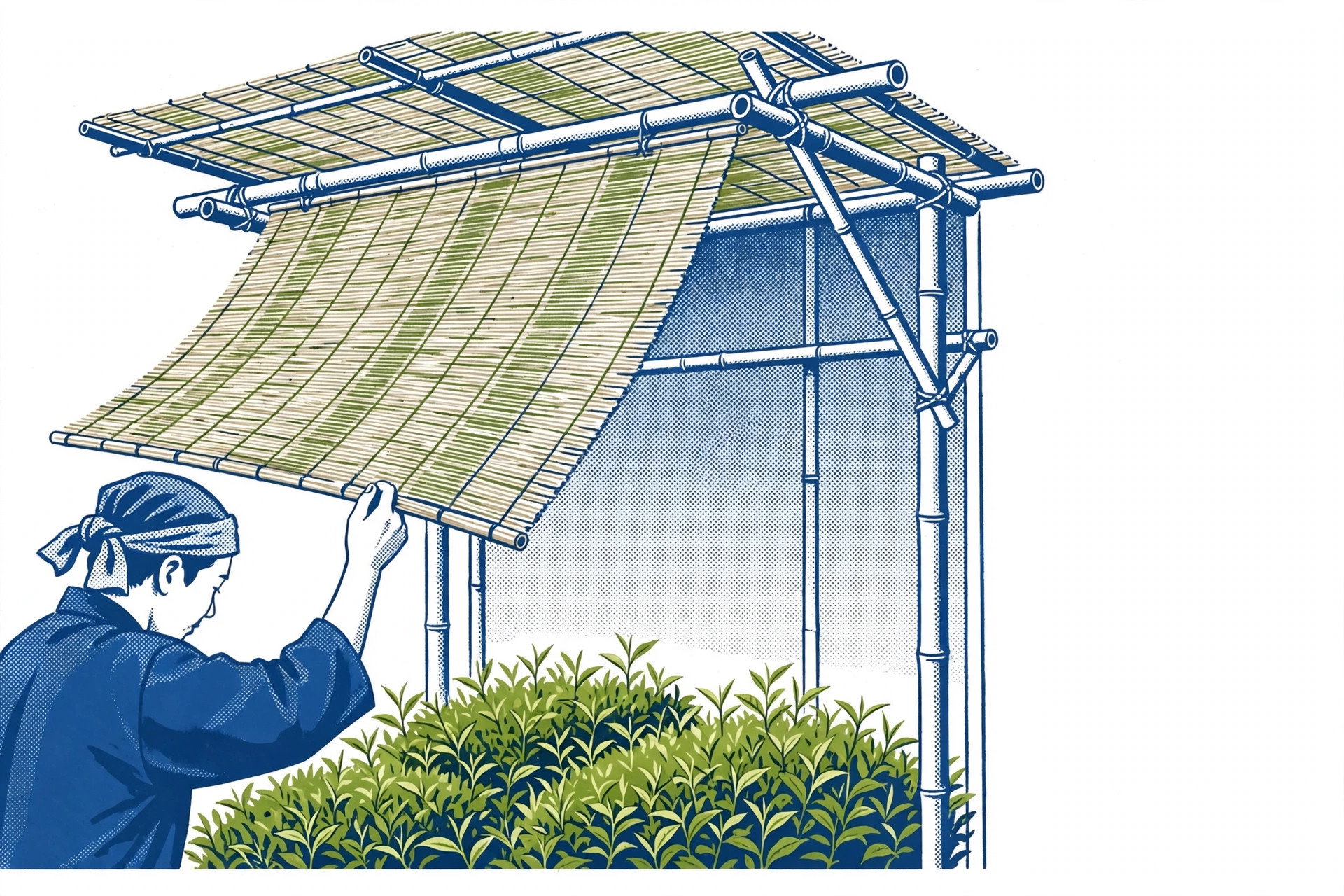
The top cannot widen, for three physical reasons. Season: top tencha uses only the first flush, and the roughly two to three weeks of shading before picking commit the field to that single crop. Hands: Uji's hand-picked tencha depends on manual labour, and its 2025 first-flush price was 216% of the year before. Time: a newly planted bush takes about four years to its first picking and seven to ten to stable production. In 2026's first flush, tencha traded at roughly twice the prior year in Kagoshima and about 70% higher in Shizuoka (agriculture ministry figures) — the climb has not stopped.
Fact
A June 2025 report by a Kyoto tea-industry body, publishing Zen-Noh Kyoto tea market data: hand-picked Uji tencha's 2025 first flush averaged ¥43,330 per kilogram, 216% of 2024's ¥20,024. The agriculture ministry puts the 2025 all-season tencha average at ¥8,562 per kilogram (first flush ¥10,030) and sencha's average at ¥1,746.
Why the pool cannot widen: acreage, time, certification
Our reading
Our reading: the constraint on the high-price pool is not demand. It is the stock of supply. Japan's tea acreage in its main producing prefectures fell from 39,200 hectares in 2014 to 30,100 in 2023, down 23% in a decade. The largest crude-tea prefecture since 2024 is Kagoshima (44%), carried by mechanised flatland fields — not by places like Uji, which run on hands and slopes.
And the export pool has a certification gate: about 63% of the green tea shipped to the US and to the EU and UK in 2025 moved under organic-equivalence arrangements — only certified fields may enter. Shrinking acreage, a four-year wait for new fields, and a certification gate: stacked together, they mean the top of the gradient cannot grow just because the price did.
The agriculture ministry has written the concern itself. Its April 2025 basic plan warns that if production keeps shrinking, combined domestic and export demand may become impossible to meet; in its outlook, domestic demand falls from 71,000 tonnes in 2023 to 63,000 in 2030, with total demand held up only by export growth. The other defence is the name: on 10 July 2026, "Japanese Tea" was registered as a Geographical Indication, with the ministry citing Chinese-produced "Uji matcha" circulating overseas as part of the background. When volume cannot grow, you defend the name first.
The strongest counter-argument: it is just a bubble
The rebuttal worth taking seriously: when the matcha craze cools, prices will fall back on their own, and "structural shortage" will look like an excuse for a bubble. For the powdered half, we agree — food-grade capacity is visibly arriving (the decade's tripling of tencha output is the evidence), and that end of the gradient will loosen first. But the ceremonial pool's constraints are not a mood on the demand side; they are a stock on the supply side: acreage, one shaded flush a year, certified fields. Cooling demand can stop that pool's price rising. It cannot make the pool bigger. The test is written down here: if the 2027 first-flush auctions show hand-picked Uji tencha prices falling sharply on rising volumes, the pool can widen after all — and this article's judgement is wrong.
Conclusion: what is scarce was never "matcha"
Back to the thesis. The world is not short of the category called matcha — that category's output tripled in a decade and its export value doubled in a year. The world is short of a small pool of shaded first-flush leaf, locked by acreage, season and certification — which happens to be exactly what the word "matcha" means in a consumer's mind overseas. Over the next year, watch three things: the 2027 first-flush auction prices and volumes, the official 2026 tencha production figures, and progress toward the ¥81 billion export target for 2030. Volumes before prices — the volumes will tell you whether the shortage was real.
Sources & references
- Ministry of Agriculture, Forestry and Fisheries, "The situation surrounding tea," October 2026 (export value/volume/prices, powdered composition, destinations, organic share, tencha production and prices, acreage, basic plan and subsidies, GI registration)
- Ministry of Agriculture, Forestry and Fisheries, "FY2025 exports of agricultural, forestry and fishery products and food" (cross-check of green-tea export growth)
- Kyoto Prefecture tea-industry body, "Emergency report on Kyoto-grown new tea," 11 June 2025 (Zen-Noh Kyoto tea market: hand-picked Uji tencha ¥43,330/kg)
- Ministry of Agriculture crop statistics, 2023 tea (acreage 39,200 ha → 30,100 ha)
- Ministry of Agriculture, "2025 tea: picked area, fresh-leaf harvest and crude-tea production" (crude tea 68,000 t, Kagoshima 44%)
- MLIT / Japan Tourism Agency multilingual database (about four years from planting to first picking; stable production at about 7–10 years)
- Kagoshima Customs, FY2025 special feature (customs-district view of US-bound exports)
Spotted an error or something out of date? Let us know via the contact page. Corrections are reflected in the updated date.
Original research and analysis by JNoted. Please cite with a link; full republication or commercial use requires prior permission.