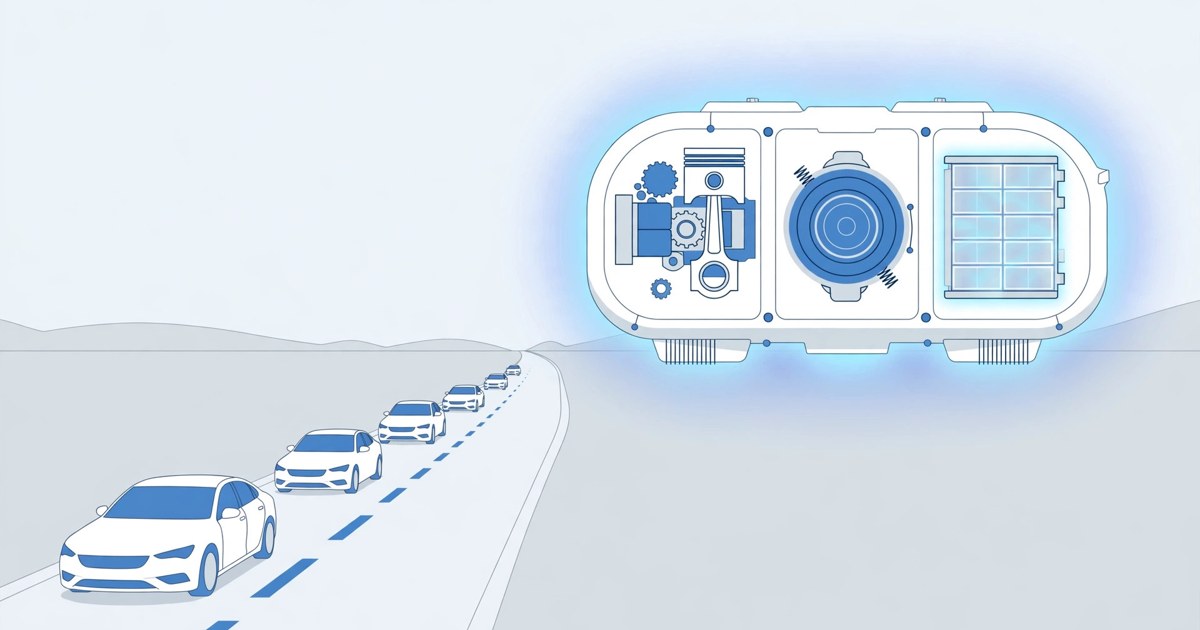
Why Do Japan's Secondhand Goods Sell Worldwide?
Cameras, trading cards, designer bags — Japan's used goods reach the world through three main channels\: eBay direct sales, Mercari plus proxy services, and KOMEHYO selling for itself — and the channels also connect to each other. Start by separating three numbers. The 73% counts sellers, not money; the ¥112.2bn includes new goods; the 33.2% is a revenue mix, not profit. The channels demonstrably work. How much authentication adds to the price of any single item — nobody has published the comparison that would prove it.
Pages · 1/7
Japan's secondhand goods do not owe their worldwide sales to being cheap — in quite a few categories, they sell for more than comparable goods from elsewhere. Each item's condition is put on record, and the record stands up to scrutiny. What overseas buyers pay extra for is that certainty
Used cameras and lenses · watches · retro games · anime and trading cards — used goods from Japan's market, sold worldwide.
Findable
On global markets, domestic platforms, cross-border services — searchable
Checkable
Real photos, model numbers, condition — grading and authentication where they apply
Buyable
Payment, proxies and logistics — from order to delivery
73%
Evidence · in 2025, 73% of Japanese eBay sellers sold goods that were not new
Sellers, not sales value (eBay, Used in Japan Report) — already in use, not a proposal
The record's path to the buyer — this article's framework, not a measured division of causes.
Pages · 2/7
Which categories are moving
Why do overseas buyers want Japan's used goods? By category: discontinued scarcity, stock that exists only in Japan, condition with a record, price. The evidence differs too — hardest for cameras and trading cards, mostly company statements for games and anime.
Cameras and lenses
Where the value isCondition and full model line-ups: used items were about 80% of digital-camera sales by Japanese sellers on eBay (Q1 2025); cameras are the No. 2 cross-border category by value
Main channelsMainly eBay direct
Watch outFunction and fungus rest on the seller's word; cross-border returns are expensive
Trading cards
Where the value isDiscontinued scarcity, with grading turning condition into a score: graded-card sales roughly doubled year on year in Q2 2026 (eBay)
Main channelseBay + PSA grading; domestic platforms via proxies
Watch outThe "5x" is a price gap between different cards, not a premium earned by grading
Watches and luxury
Where the value isDeep stock from a luxury-consuming nation, with condition on record; dealers' overseas + duty-free equivalent share rose to 33.2% within a year
Main channelsDealers selling direct; eBay authentication delivery
Watch outThe highest counterfeit risk; authentication covers only bags, jewellery and watches
Games and anime collectibles
Where the value isJapanese editions and careful storage; Suruga-ya's overseas store runs at roughly ¥3bn a year (its president, in an interview)
Main channelsSuruga-ya's overseas site, Mandarake mail order, proxies
Watch outThe thinnest disclosure; scale is mostly self-reported, and Mandarake publishes no overseas share
Pages · 3/7
Three modes, one diagram
One item can reach an overseas buyer by three main modes. Fees differ; so does who carries responsibility — and the modes are not sealed off, as the pipe at the bottom of this page shows.
Supply · inside Japan
Individual sellers and households
The stock
Cameras, cards and designer goods — listed on domestic platforms first, or sold to a buy-back shop
Buy-back shops and dealers
Sorting and grading
KOMEHYO, Suruga-ya and others buy the goods in and route them by condition
Channels · three ways across
eBay
Direct to the world
Sellers face global buyers; the platform provides authentication and buyer protection; customs is the seller's problem
Mercari + proxies
Sold at home, carried abroad
The seller ships only to a proxy inside Japan; the proxy receives, checks briefly, consolidates and forwards
KOMEHYO
The dealer is the channel
Its own overseas stores, authentication and refurbishment — trust rides on its own name
Buyers · worldwide
Overseas buyers
Ordering through a screen
They buy the goods plus a record of condition; who answers when something goes wrong depends on the channel
The channels also connect. Since February 2025, Rakuten Rakuma's official shops — mostly reuse businesses — list directly on eBay's US site under an official plan: Rakuma handles the English and the international shipping, and plan items fall under eBay's Authenticity Guarantee, handbags first.
Pages · 4/7
Why buy what you cannot see?
Buyers order because "only the seller knows" became a record that can be checked. Seven steps carry an item to a buyer overseas; where a step runs thin, risk leaks out.
Identify
What it is, which year, which version
Inspect
Condition and flaws, written down
Authenticate
Genuineness and grade, signed by a third party or a dealer
Price
Priced on the record, not on the story
List
Translated, and listed where the buyer shops
Ship
Customs, delivery and tracking, handled by someone
Aftercare
When the item is not as described, someone answers for it
In the proxy channel the chain visibly thins: inspection is only a surface check, authentication is absent, aftercare is tightly limited by each service's terms — whatever the terms do not cover stays with the buyer.
Pages · 5/7
One payment, three ways of splitting it
The sale price is not profit. The same payment is split entirely differently on each channel.
The three modes
eBay direct
The platform takes a cut
About 13.6% of the total including shipping, plus $0.40 per order; authentication is free to sellers, paid for by eBay. International shipping, customs and returns are the seller's own
Mercari + proxy
Two separate charges
The seller pays Mercari 10%; the transaction ends inside Japan. The buyer separately pays the proxy fee (Buyee: ¥500 per order), inspection and protection plans (¥300–500 per order) and both legs of shipping
KOMEHYO
Everything inside the spread
No fee table: it buys low, authenticates and refurbishes, then sells at a markup. Appraisers, stores and overseas operations all come out of the spread, which is never disclosed per item
A worked example (illustrative figures, not industry margins): an item sells on eBay for ¥20,000 including shipping. The platform takes about ¥2,720 plus $0.40; the seller then pays international shipping and customs handling. ¥20,000 is the sale price, not what the seller keeps — costs vary by category and destination, and sellers' net profit is published by nobody.
Pages · 6/7
Three pillars: goods, routes, records
With six sections done, the mechanism compresses into three pillars — each with its hardest evidence, and that evidence's boundary.
The synthesis
Goods worth buying
Pillar one · the goods
Categories: cameras, watches, retro games, collectibles. Evidence: KOMEHYO alone bought ¥104.1bn from individuals in the year to March 2026. Boundary: deep stock does not by itself sell — instruments still have no checkable overseas data
Routes that sell them
Pillar two · the routes
Each mode has volume evidence: eBay seller numbers +19% a year on average / Mercari cross-border ¥112.2bn (including new goods) / KOMEHYO overseas + duty-free at 33.2% — three different bases, not addable. Boundary: the modes cooperate and cross, not three separate roads
Records that can be checked
Pillar three · the records
Five jobs: disclosure, grading, authentication, refurbishment, guarantees. Boundary: authentication covers only bags, jewellery and watches; proxies state plainly they do not authenticate. Records prove that the mechanisms exist — not what they are worth
The records pillar reaches only as far as "the mechanisms exist". What they are worth is the next page's line to draw.
Pages · 7/7
The judgment: what is proven, and what is not
Proven — cross-border trade really happens, and reaches widely: the defined group of Japanese sellers (scope in section two) sold used goods into 211 overseas markets in 2025. Used-goods sellers grew +19% a year on average (2023–2025, eBay). Mercari cross-border: ¥112.2bn (year to June 2026, incl. new goods). KOMEHYO overseas + duty-free: 33.2% of group revenue (April–June 2026).
Not yet proven — what the premium is made of. What can be observed: in quite a few categories, Japan-sourced used goods sell for no less than comparable goods from elsewhere — sometimes for more. But how much of that gap belongs to condition records, and how much to scarcity or the exchange rate, has no controlled comparison behind it and cannot be separated out. How much authentication adds to the price or net profit of comparable goods, once the goods themselves are controlled for, is likewise unanswered.
The risks remain — international shipping · customs and taxes · returns · who bears responsibility: none has disappeared; who carries them depends on the sales model and each service's terms.
The opportunity in Japan's secondhand goods is not only the premium. It is to let more of the country's used things be found, judged and bought by buyers around the world.
73% of Japan's eBay sellers sell used goods (2025; sellers, not sales). Mercari cross-border trade\: ¥112.2bn in FY2026, ~9% of its Japanese total, incl. new goods. KOMEHYO overseas + duty-free sales\: 33.2% of group revenue (Apr–Jun 2026). Channels are expanding; a grading premium is unproven.
Key takeaways
- eBay, Used in Japan Report (August 2026): in 2025, 73% of Japanese sellers on eBay sold secondhand goods — a share of sellers, not of sales value. The number of sellers handling used goods grew at an average 19% a year over 2023–2025. The headline "sold into 211 markets" counts only small and mid-sized sellers with at least $10,000 in annual sales; that group reaches 20 markets on average, and 92% of them export used goods. The report is published by eBay's policy arm, rests on internal platform data with no external audit, and Japanese sellers' secondhand transaction value has never been disclosed.
- eBay's Japan authentication centre covers only three categories — bags (from $500), jewellery (from $500) and watches (from $2,000) — for US-bound sales. It has been free to all Japanese sellers since April 2025, paid for by eBay. Sneakers and trading cards are outside Japan's authentication service; card grading is done by PSA, a US company.
- eBay fees and rules: final value fees of 13.6% for most categories (on the total sale amount including shipping) plus $0.40 per order. Since October 2025, shipments from Japan to the US under $2,500 must in principle go Delivered Duty Paid — after the US ended its small-parcel exemption, the cost of handling customs moved onto the seller's side.
- Mercari charges sellers a flat 10%. Buyee has been Mercari's official partner since November 2019: it buys on Mercari through an official account on the overseas buyer's behalf, and the seller simply ships to Buyee's warehouse in Japan. Buyee charges a ¥500 purchase fee per order and no payment fee; inspection plans cost ¥300 per order, delivery-protection plans ¥500, with 30 days of free storage. ZenMarket charges per item (¥800 per Mercari item) with 60 days free storage; FROM JAPAN charges ¥500 per item plus a ¥500 per-item protection plan, with 45 days free storage.
- Where proxy liability ends (from the companies' own terms): a proxy is not the seller. Buyee states that it does not authenticate — a counterfeit that reaches the buyer is covered by none of its protection plans; electrical faults are not compensated; returns are in principle impossible. Buyee refunds only buyers who purchased an inspection-type plan and whose warehouse check found the wrong item or obvious damage. ZenMarket likewise states that it verifies neither authenticity nor function, that returns depend on the original seller's consent, and that for used items from Mercari and Rakuma "compensation is not possible in most cases."
- Mercari's own cross-border move: its official app launched in Taiwan and Hong Kong in September 2025 and entered the US in June 2026, promising no third-party proxy and inspection of every item before shipping. Mercari's cross-border transaction value was ¥112.2bn in the year to June 2026, about 9% of its Japanese transaction value of ¥1,285.6bn — a figure that includes new goods and is not a secondhand measure.
- KOMEHYO: in the year to March 2026 its overseas ratio was 12.1% and its domestic duty-free ratio 14.6% — overseas sales plus domestic duty-free sales were equivalent to 26.7% of group revenue. In the April–June 2026 quarter both ratios stood at 16.6%, equivalent to 33.2% combined, across 347 group stores (304 in Japan, 43 overseas). Its authentication system: appraisers are trained by a dedicated department (a course averaging about three months) and may assess goods only after passing internal certification; items pass through up to five layers of checks; the same quality management is applied overseas.
- The reference line (used cars): Finance Ministry figures show 1,490,242 used passenger cars exported in 2025 (+9.3%), worth ¥1.6079tn (+17.4%), an average of about ¥1.079m (+7.4%, calculated by JNoted). The annual average exchange rate barely moved (a contribution of roughly zero), while new-car prices rose 25% in two years and both the domestic market and the destination mix shifted — the 7.4% cannot be separated out, and cannot be credited to auction grading.
Japan's secondhand goods sell worldwide because three things connect: stock worth buying, three main modes, and mechanisms that turn condition into a checkable record.
The three things
Stock worth buying
Pillar one · the goods
Deep inventories of cameras, watches, trading cards and designer bags, with condition on record
Three main modes
Pillar two · the routes
eBay's global direct sales, domestic platforms such as Mercari carried abroad by proxy services, and professional dealers like KOMEHYO selling for themselves — modes that also cooperate and cross
Mechanisms that turn condition into a checkable record
Pillar three · the record
Disclosure, grading, authentication, refurbishment, platform guarantees
Where the evidence stops
What is proven is volume
Proven
Seller counts, cross-border transaction values and dealers' revenue mixes all show checkable growth, each on its own basis — the bases differ and cannot be added together
What is not proven is price
Not proven
How much authentication adds to what any single item sells for has no comparison data behind it
Risk is redistributed and priced
Risk
It has not disappeared — in the proxy mode, whatever each service's terms do not cover is left with the overseas buyer
First, the cast: who is who on the three channels
eBay Japan — operator of the global direct channel. It connects Japanese sellers to a worldwide market, and runs an authentication centre in Japan that checks bags, jewellery and watches before they are sent on to overseas buyers. Its Used in Japan Report (August 2026) is a key source for this article — and also an advocacy document produced by eBay's policy arm. Every figure in it is the platform's own internal data; this article labels each one's basis as it goes.
Mercari and the proxy companies — domestic platform plus agent carriage. Mercari is Japan's largest consumer-to-consumer marketplace, and its sellers trade only inside Japan. The goods cross the border because proxy companies carry them: Buyee (operated by tenso, part of the BEENOS group) is Mercari's official partner; ZenMarket and FROM JAPAN are independent proxies. They buy the item in Japan in their own name, receive it, inspect it, consolidate parcels and ship it to the overseas buyer. Since September 2025 Mercari has also run its own app for overseas buyers, starting to bypass the proxies.
KOMEHYO (KOMEHYO Holdings) — the professional dealer's model. It buys, authenticates, refurbishes and sells through its own stores, including overseas. In its accounts, the "overseas ratio" is overseas group sales plus exports (excluding domestic duty-free), and the "domestic duty-free ratio" is what visiting tourists buy tax-free in its Japanese stores; both ratios share consolidated sales as the denominator and do not overlap.
PSA — the US company that authenticates and grades trading cards, the largest card grader in the world. Japanese sellers are its users, not its inventors: on the card line, the "authentication" runs on American infrastructure.
The Ministry of Finance and USS (the reference line) — used cars are Japan's largest secondhand export category: 1.49 million passenger cars in 2025 on Finance Ministry figures. Their auction grading system (USS, a 10-grade scale) is the oldest large-scale practice of "turning condition into a record." This article demotes cars to a reference case: the system has demonstrably run on automobiles for decades, but nobody can separate how much of the 2025 rise in average used-car export prices belongs to grading. See section five.
How the money flows — Direct: the overseas buyer pays → the platform takes its cut → the Japanese seller ships it themselves (or via the authentication centre). Proxy: the overseas buyer pays the proxy → the proxy buys the item inside Japan → the seller ships to the proxy's warehouse and is paid → the proxy consolidates and ships overseas. Dealer: a Japanese consumer sells to KOMEHYO → KOMEHYO authenticates and grades → the item is routed to domestic stores, duty-free stores, overseas stores or auctions. At every step, the price includes payment for one thing: the record of what condition this used item is actually in. What that record is worth is a separate question.
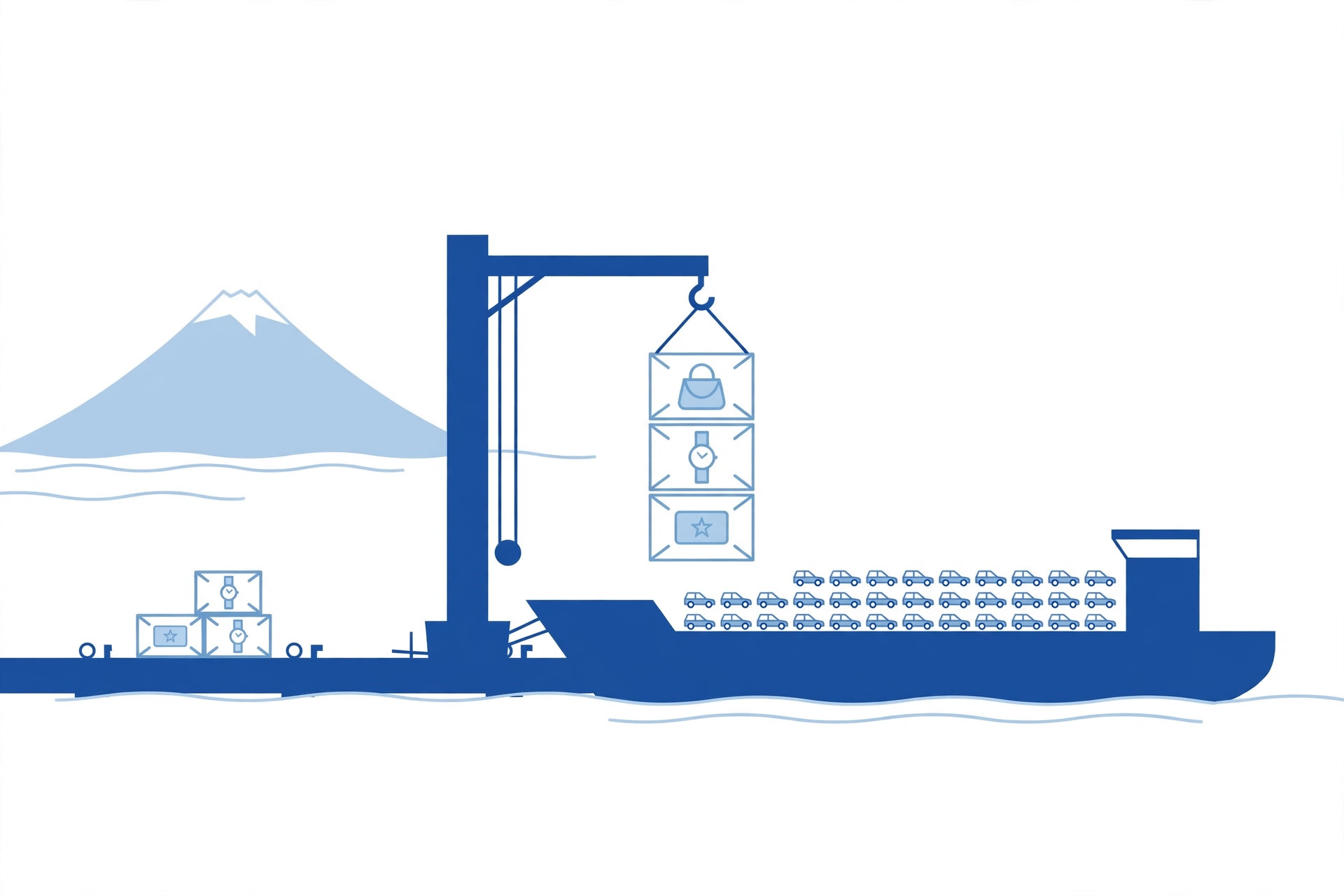
One — Supply: the goods first, then the roads
Before asking why things sell, look at what Japan actually has.
Stock whose condition is on record. One distinction first: "Japan's secondhand goods" in this article means used goods circulating in Japan's market — not goods made in Japan. Most designer bags and watches are foreign brands; they simply pass through Japan's buy-back and retail networks. Along the way, condition gets recorded layer by layer: the shaken system leaves used cars a continuous service history (cars are the reference case — section five); specialist camera shops run their own inspection and warranty practices; buy-back shops sort by grade and price accordingly. That is the endowment: where an item has been, and in what state, can be checked.
Deep stock of collectibles. Pokémon cards, game software, anime goods — Japan is both the issuing country and one of the world's largest stock markets for them. The stock of watches and designer bags comes from decades of accumulation in a major luxury-consuming nation: KOMEHYO alone bought ¥104.1bn of goods from individuals in the year to March 2026.
The cross-border evidence differs sharply by category. Stated separately:
Cameras and lenses
Where the value iseBay, Q1 2025: digital-camera sales by Japanese sellers ran at about 1.5 times the previous year, and roughly 80% of them were used. In Q2 2026, cameras and photo equipment were the second-largest cross-border category by value, with lenses, film cameras and digital cameras all in the top ten by transaction value
Main channelsMain channel: eBay direct
Watch outRisk: function and optical flaws rest on the seller's description; cross-border returns are costly; platform authentication does not cover cameras
Trading cards
Where the value iseBay: authenticated trading cards grew 98% in 2024 (the original report does not say whether that is value or volume). Trading cards overall ran at about 1.74 times the previous year in 2025, with single cards accounting for about 70%. In Q2 2026, graded-card sales were roughly double the year before
Main channelsMain channels: eBay plus PSA grading; domestic platforms via proxies
Watch outRisk: "graded cards sell for over 5x ungraded ones" is an observed gap between different cards, not a before-and-after comparison of the same card
Watches and luxury
Where the value isKOMEHYO's overseas + duty-free equivalent ratio rose from 26.7% to 33.2% in a year (including new-store effects). Japan's retail gold price rose about 70% in 2025, lifting resale prices of watches and jewellery directly through their material value
Main channelsMain channels: KOMEHYO and other dealers; eBay authentication delivery
Watch outRisk: the category where counterfeits concentrate; authentication coverage is limited, and the proxy channel explicitly does not authenticate
Games and anime collectibles
Where the value isSuruga-ya's overseas mail-order site opened in 2019; its president puts it at roughly ¥3bn a year — still small against total sales of ¥46.18bn in the year to August 2025. Mandarake's sales were ¥15.18bn in the year to September 2025 (+5.0%), but operating profit fell 13.7%, and it discloses no overseas share
Main channelsMain channels: Suruga-ya's overseas site, Mandarake mail order, proxies
Watch outRisk: overseas scale is mostly self-reported or undisclosed; it cannot be assumed this category is "exploding"
Musical instruments
Where the value isIshibashi Music runs an English-language international store and a Reverb shop, and actually ships used and vintage instruments worldwide. Shimamura serves inbound tourists with tax-free sales and states plainly that it offers no international shipping
Main channelsMain channels: Ishibashi's own cross-border sales; eBay's refurbishment programme
Watch outRisk: no official export value or overseas share exists at all — the weakest evidence of any category, qualitative facts only
The supply conclusion should stay modest: Japan holds stock worth buying — a fact. But "good goods exist" is not "they sell." Between goods scattered across thousands of households and shops, and one item on an overseas buyer's screen, sits an entire set of channels.
Two — Three roads: how the goods leave Japan
Supply · inside Japan
Individual sellers and households
The stock
Listed on Mercari, Yahoo! Auctions or Rakuma — or sold to a buy-back shop
Buy-back shops and dealers
Sorting and grading
KOMEHYO, Suruga-ya, BuySell: they buy in, authenticate, and route by grade
Channels · three ways across
eBay
Direct to the world
Sellers list straight onto a global market; the platform takes a final value fee and provides an authentication centre and buyer protection
Mercari + proxies
Domestic platform + agents
The seller's transaction finishes inside Japan; the proxy buys, receives, consolidates and forwards, and earns a service fee
KOMEHYO
The dealer itself
It sells to overseas buyers and duty-free stores under its own stores, its own authentication and its own name
Buyers · worldwide
Overseas buyers
Ordering and bearing risk
On eBay there is platform protection; in the proxy channel, returns and compensation are limited by the proxy's terms, and whatever falls outside them stays with the buyer
Road one: eBay — the seller faces the world directly
eBay is the most direct of the three roads. Japanese sellers run storefronts on the platform and face global buyers themselves: pricing, shipping and aftercare are their own work, while the platform provides the market, payments, guarantee rules and part of the trust machinery.
Its sense of scale comes from seller counts. The Used in Japan Report (eBay, August 2026) states that in 2025, 73% of Japanese sellers on eBay sold used goods; sellers handling used goods grew at an average 19% a year over 2023–2025; and 61% of those who first listed used goods in 2025 had never sold on eBay before. The headline "sold into 211 markets" has a strict scope: only the sellers the report calls small and mid-sized — at least $10,000 a year in sales on eBay. Per seller, that group delivered used goods to 20 overseas markets in 2025; 92% of them export used goods.
Fact
How to read the Used in Japan Report (eBay, August 2026): published by eBay's policy arm, with policy proposals of its own. All figures are internal platform data, no external audit. It publishes shares of seller counts and markets reached — sellers' secondhand transaction value and item counts have never been released. Its "roughly ¥91tn of household hidden assets" cites a Mercari survey, not eBay data. This article uses its seller shares and category rankings, never to size a market.
The platform equips this road with two pieces of infrastructure. First, the Japan authentication centre (opened December 2023). When bags, jewellery or watches clear the threshold prices ($500 for bags, $500 for jewellery, $2,000 for watches, for US-bound sales), the seller first ships the item to the domestic centre; only items that pass are sent on to the buyer, and failures go back to the seller with a refund to the buyer. It opened to all Japanese sellers in April 2025; eBay pays for the authentication, and the buyer pays a flat $35 international shipping charge. Note the scope: sneakers and trading cards are not part of Japan's authentication service — card grading runs through PSA in the US. Second, the regularisation of shipping and customs: the official SpeedPAK service lets individual sellers without their own courier contracts ship from a single parcel. But costs are rising — after the US abolished its small-parcel exemption in October 2025, shipments from Japan to the US under $2,500 must in principle go Delivered Duty Paid, putting customs and tax handling on the seller's side.
The arithmetic of this road: final value fees of 13.6% for most categories (on the total including the shipping the buyer paid) plus $0.40 per order; listing is free for the first 250 items a month. What sellers earn is the sale price minus those fees and shipping — what the platform publishes is always the growth of transaction value, never sellers' profit.
Road two: Mercari + proxies — the seller stays home, the goods leave
The second road is structured completely differently. A Japanese seller on Mercari makes exactly one domestic transaction: ship the item to an address in Japan, receive the money, done. What carries that domestic transaction across the border is a proxy company.
Take Buyee, the official partner, as the example. The flow has four steps: the overseas buyer orders on Buyee → Buyee buys the item on Mercari through its official account, on the buyer's behalf → the seller ships the item to Buyee's warehouse in Japan → Buyee inspects the goods and rates the seller (the seller's transaction ends here), then consolidates and ships overseas. Rakuma's arrangement with Buyee dates from June 2021, and its sellers likewise never deal with the overseas buyer. ZenMarket and FROM JAPAN are independent proxies on the same model, covering more sites than Buyee does — Yahoo! Auctions, Rakuten Ichiba and others.
Rakuma also operates an official pipe that skips proxies altogether. Its official shops — mostly reuse businesses — began a trial in May 2024 and, from February 2025, list goods directly on eBay's US site under the Rakuma Overseas Omakase Plan. Rakuma's side handles English communication and international shipping, and shops sell overseas using much the same procedures as a domestic sale; the plan starts with fashion items, and goods under it fall under eBay's Authenticity Guarantee, handbags first. The boundaries between the three roads are not hard: a domestic platform can pipe its own merchants straight into the global market.
Fact
What the proxies charge (each company's official site, checked October 2026): Buyee charges a ¥500 purchase fee per order, no payment fee, free consolidation, and 30 days of free storage. Optional plans are priced per order — an inspection plan at ¥300, a delivery-protection plan at ¥500, and a standard plan combining both at ¥500. ZenMarket charges per item: ¥500 per item from ordinary stores, ¥800 per item for Mercari goods and Yahoo! Auctions bids; storage is free for 60 days, then ¥50 per item per day. FROM JAPAN charges a ¥500 service fee per item plus a ¥500 per-item product protection plan; storage is free for 45 days. Both legs of shipping — domestic and international — are paid by the buyer at cost.
A proxy earns an explicit service fee, not a spread: it holds no inventory, sets no prices, and is not the seller. That positioning decides the allocation of responsibility covered in the next section — and it is the most commonly misunderstood point on this road. Many buyers believe they are "buying from a Japanese shop," when the shop's transaction was already completed inside Japan.
This road is now being rewritten by the platform itself. Mercari first let Taiwanese buyers order directly on its web version in August 2024, launched an official app for overseas buyers in September 2025 (Taiwan and Hong Kong first), and entered the US in June 2026 — promising no third-party proxy, inspection of every item before shipping, and compensation for damage or loss. Its cross-border transaction value reached ¥112.2bn in the year to June 2026, about 9% of its Japanese transaction value (a figure that includes new goods; it is not a secondhand measure). The proxy model spent seven years opening this road; the platform is now taking part of it back in-house. The relationship between proxies and platform is shifting from partnership to competition.
Road three: KOMEHYO — the dealer is the channel
The third road has neither a platform nor an agent. KOMEHYO buys, authenticates, prices and sells through its own stores overseas. From start to finish, the buyer faces one and the same company.
Its trust system is the heaviest of the three roads, because every step has an official description that can be checked:
Fact
KOMEHYO's quality management (the company's own account): a dedicated department trains appraisers and sales staff — a course averaging about three months covers product knowledge and counterfeit detection for each category, and only those who pass internal certification across multiple assessments may evaluate goods, with remote follow-up by senior appraisers and regular retraining after that. AI authentication support is used for categories such as designer bags. Purchased goods are gathered at a product centre, where senior appraisers re-check flaws and the appropriateness of grading, after which specialists clean, polish, re-polish gemstones and overhaul watches before sale. Including the pre-auction check, goods pass through up to five layers of inspection. The company maintains a large product and transaction database and shares counterfeit intelligence with peers. Its official account states explicitly that the same quality management is applied overseas as in Japan.
The results on paper: in the year to March 2026, KOMEHYO's sales were ¥221.7bn (+39.4%) and purchases from individuals ¥104.1bn (+32.0%). Its overseas ratio was 12.1% and its domestic duty-free ratio 14.6% — overseas sales plus domestic duty-free sales were equivalent to 26.7% of group revenue. In the April–June 2026 quarter, sales were ¥65.82bn (+42.7%), the two ratios stood at 16.6% each — equivalent to 33.2% combined — and the group had 347 stores, 43 of them overseas. The ratio needs to be read with restraint: it says how much of the revenue mix "faces overseas buyers," not how much of the profit authentication earned; the rise also mixes in rapid store openings, which the accounts do not separate out. The newer second-quarter figures are due on 12 November 2026 and were not yet out when this article was finalised.
Its routes overseas are not only stores: KOMEHYO runs an official eBay store (since 2015, with no sales disclosed), and its B2B auctions count more than 2,700 participating companies cumulatively, with overseas firms bidding among them. Notably, its domestic online shop ships only within Japan — overseas buyers use proxies such as WorldShoppingBIZ. Even the most professional dealer borrows the second road for its web shop.
Among its peers, BuySell shows most clearly how "grade decides destination": lower-grade C and D brand goods are shipped to China, repaired and sold via livestream, while top-grade S and A goods go to the US and elsewhere. Its Hangzhou joint venture was established on 16 October 2026 and is due to start business on 1 December — with no operating volumes disclosed yet.
Three — Never seen the item. Why buy it?
The basic problem of secondhand trade is that the information sits on one side: condition, authenticity, repair history — only the seller knows. Buyers who cannot check have to price everything as if it were of average condition, so good goods get marked down too, and honest sellers leave. Economists call this a market for lemons. Crossing a border magnifies it: the buyer can barely even return the item.
The three channels' answer is to turn "only the seller knows" into a record the buyer can check. That job splits into five different jobs, with entirely different costs and credibility:
- Disclosure of condition: the seller states flaws honestly. The auction sheet is its scaled-up form — USS inspectors grade every car on a 10-point scale and the results sit in a searchable database. It verifies what a car has been through, not whether it is genuine.
- Grading: condition turned into a score. Trading-card grading is performed by PSA in the US; the score travels with the card, and buyers worldwide use the same ruler.
- Authentication: answering "is it real?" — eBay's Japan centre does this for bags, jewellery and watches; KOMEHYO relies on its own appraisers with AI support. The proxy channel explicitly does not do this job.
- Refurbishment: repairing, cleaning and polishing before sale. KOMEHYO's product centre and camera shops' inspection-and-warranty practices belong here — they change the item's condition, not merely describe it.
- Platform guarantees: when something goes wrong, someone pays. eBay's buyer protection and Mercari's official-app compensation for damage and loss belong here; they do not improve information, they underwrite outcomes.
From listing to delivery, an item passes along a seven-link chain:
Identify
Model, year and version matched first
Inspect
Condition and flaws recorded one by one
Authenticate
Genuineness and grade, signed by someone
Price
Priced on the record
List
Translated and listed where the buyer shops
Ship
Customs and delivery run by the rules
Aftercare
A path for when the item is not as described
The three channels differ completely in how thick this chain is. The eBay road: listing and shipping ride on platform tools, authentication covers three categories, and platform guarantees underpin aftercare. The KOMEHYO road: all seven links sit inside one company — the thickest chain and the highest cost, all of it hidden in the spread. The proxy road: the chain visibly thins — the warehouse check confirms only that "the goods match the order and show no obvious damage," authentication is absent, and aftercare is tightly limited by the services' terms, with whatever they do not cover staying with the buyer.
Fact
How the proxies divide responsibility (the operative points of their own terms and help pages): Buyee — once an order is placed it cannot in principle be cancelled or returned; Buyee provides no warranty on goods; its warehouse inspection does not authenticate, and a counterfeit that reaches the buyer is covered by none of its protection plans; electrical and functional faults are not compensated. Buyee refunds only buyers who purchased an inspection-type plan and whose warehouse check found the wrong goods or obvious damage. ZenMarket — it does not check function and does not verify authenticity (its site lists "what we don't do"); returns depend on the original seller's agreement, and refunds happen only after the seller has refunded ZenMarket; for used goods from Mercari and Rakuma, compensation "is not possible in most cases." FROM JAPAN's protection is likewise a paid add-on plan.
So the accurate version of "buyers dare to buy": the risk has not vanished; it has been divided. Recordable condition risk is pushed down by disclosure, grading and authentication. What remains is caught by guarantee clauses on the platform road, by the dealer's name on the dealer road, and on the proxy road is left with the buyer — who can buy back a small slice (wrong item, damage, loss) as an optional plan at a few hundred yen per order. Risk is transferred and priced — the most important line between this article and any "Japan's used goods sell worldwide on trust" telling.
Four — One transaction: who earns what
Lay the money of the three roads side by side (rates as on each company's official pages in October 2026):
The eBay road: the overseas buyer pays the price and shipping → the platform takes about 13.6% of the total plus $0.40 per order → the seller handles shipping and, for the US, DDP customs treatment. For goods passing the authentication centre, the platform pays for authentication and the buyer pays a flat $35 international shipping charge. Sellers earn the difference between price and costs; the platform earns the cut — and the cut is the platform's revenue, not the seller's profit.
The Mercari + proxy road: the seller completes a sale on Mercari, pays the 10% fee, and receives exactly the domestic price — no "overseas premium" reaches their hands in this transaction. On top of the price, the overseas buyer pays the proxy fee (Buyee ¥500 per order, or ZenMarket ¥500–800 per item), the optional protection plan (¥300–500 per order or item), and both legs of shipping. The proxy earns a service fee unrelated to what the goods sell for; it is also not responsible for their authenticity or function.
The KOMEHYO road: there is no fee table. Its money sits in the spread between purchase price and sale price, which must cover appraisers, the product centre, refurbishment, stores and overseas operations. Group operating profit is public (¥9.29bn in the year to March 2026), but the spread on any single item is never disclosed — "sells for more" does not mean "earns more" on this road either.
The three roads share one feature: nobody publishes sellers' net earnings or the profit split of a single transaction. Transaction-value growth in platform reports and revenue mix in dealers' accounts are evidence about volume. Reading a sale price as profit, or a transaction total as sellers' income, is the most common misreading in this genre; this article does not make it.
Five — Counterarguments: five explanations to weigh
One: platform data has a position. The Used in Japan Report comes from the platform's policy arm; its aims include elevating "Used in Japan" into a strategic export field and arguing for lighter practical burdens under Japan's secondhand-goods law. It is a marketing document and a lobbying document at once. Its figures are all internal: the 73% counts sellers, the 211 markets are a subset of successful sellers, and secondhand transaction value is not published at all. Mercari's cross-border total includes new goods. Suruga-ya's overseas figure comes from a president's interview. These numbers can support "the channels are growing"; they cannot support an estimate of "the size of Japan's used-goods market" — this article never adds two platforms' volumes together.
Two: the yen's water level. The dollar-yen annual average in 2025 was almost identical to 2024, so the exchange rate cannot explain that year's growth. But a level around ¥150 to the dollar makes Japanese used goods look cheap to overseas buyers across the board and holds total demand up. When the water recedes — if the yen strengthens persistently — the channels' volumes will be tested before "trust" is.
Three: material prices and first-hand prices. Japan's retail gold price rose about 70% in 2025 (Tanaka Kikinzoku: a January monthly average of ¥13,676 per gram, and a December high of ¥25,015 per gram), directly lifting resale prices of watches and jewellery. Brands' continued increases in new-product prices lift the entire secondhand market with them. None of that rise belongs to authentication, or to the channels.
Four: not every category is growing. Instruments have no official overseas data at all. Mandarake's revenue grew while its operating profit fell. Suruga-ya's overseas mail order, at roughly ¥3bn a year, is still a single-digit share of its ¥46.18bn in total sales (calculated by JNoted from the two figures). "Japan's used goods are booming worldwide across the board" is not this article's conclusion — the evidence is uneven, category by category and channel by channel.
Five — the reference line: used-car prices still cannot be separated. Japan's largest secondhand export category grew in 2025 by +17.4% in value, +9.3% in units and +7.4% in average price (Finance Ministry). The exchange rate's contribution is roughly zero, but new-car prices up 25% in two years, a rising domestic auction market, and a shifting destination mix (the UAE's share up, Russia's down) are all present at once — how much of the 7.4% belongs to an auction grading system that has run for decades cannot be separated from the data. Which is precisely the point: the existence of a mechanism can be proven; its price contribution cannot be asserted. A footnote on maintenance costs: because auction sheets are valuable, forged auction sheets circulate — JUMVEA's website carries a standing warning about forged and altered Japanese auction sheets appearing overseas. The records of trust themselves cost money to keep trustworthy.
Six — Our reading: three pillars — two proven, one pending
Our reading
Japan's secondhand goods sell worldwide on three pillars. The first is the goods: condition and records, careful storage, deep inventories of luxury goods and collectibles — an endowment of origin that no channel can substitute for. The second is the channels: eBay direct, domestic platforms plus proxies, and professional dealers selling for themselves — three main modes that carry dispersed supply to global buyers. This pillar is proven: each of the three modes shows checkable growth in volume (eBay's seller counts, Mercari's cross-border transaction value, KOMEHYO's revenue mix). Nor are the modes sealed off from one another: Rakuma pipes its own shops straight into eBay, and even KOMEHYO's domestic web shop borrows a proxy. The third is the mechanisms: disclosure, grading, authentication, refurbishment and guarantees turn condition into a checkable record, letting buyers order goods they have never seen. But its boundary is equally clear — risk is divided and priced, not eliminated, and in the proxy channel whatever the services' terms do not cover sits with the buyer.
What remains unproven is the mechanisms' price contribution: how much more authentication makes any single item sell for still has no like-for-like comparison data. The "5x gap" is an observation across different cards, not an answer. What each party wants is not complicated: sellers want global buyers' prices, platforms want transaction value and their cut, proxies want a few hundred yen per order, dealers want the spread, and buyers want to skip inspecting goods in person. Whether this system endures depends on whether the cost of maintaining the records — authentication, re-checking, anti-forgery, customs compliance — rises more slowly than the spreads and service fees.
Watch three classes of indicators:
- Market performance: Mercari's next-year cross-border transaction value and its share of Japanese transaction value (now about 9%); KOMEHYO's full-year overseas + duty-free equivalent ratio for the year to March 2027 (published May 2027); used passenger car exports in 2026 — units, value and average price.
- Business models: the progress of Mercari's official app towards 50 countries and regions (its own target is 2028) and how the proxies respond; KOMEHYO's second quarter (published 12 November 2026) is the nearest checkpoint; if proxy terms ever add authenticity coverage, the pricing of risk will have been rewritten.
- Mechanism evidence: whether any platform or researcher publishes a comparison — same card type, same grade band — of authentication/grading against sale prices and sell-through. It does not exist today. That is a question left for the next round of research, not a monitoring indicator already in place.
Sources & references
- eBay Japan, Used in Japan Report (August 2026, eBay policy arm): 73% of Japanese sellers handle used goods (share of sellers); sellers of used goods +19% a year on average; small and mid-sized sellers with $10,000+ in annual sales reaching 211 markets https://www.ebay.co.jp/release/20260807/
- eBay Japan, 2025 Annual Cross-Border E-Commerce Report (9 March 2026): category rankings by transaction value; trading cards about 1.74x year on year; single cards about 70% https://www.ebay.co.jp/release/20260309/
- eBay Japan Q1 2025 release: digital-camera sales about 1.5x, about 80% used https://www.ebay.co.jp/image/preview/media/Pressrelease20250520.pdf ; Q2 2026 coverage (Impress Watch, reporting eBay Japan's release): cameras the No.2 category by value, graded cards about 2x https://dc.watch.impress.co.jp/docs/news/2136966.html
- eBay authenticity guarantee (Japan): covered categories and thresholds; free to all sellers from April 2025 https://www.ebay.co.jp/authenticity-guarantee/ ; eBay selling fees (13.6% for main categories plus a per-order fee) https://www.ebay.com/help/selling/fees-credits-invoices/selling-fees?id=4822 ; DDP guidance for US-bound sales https://www.ebay.co.jp/ddp-info
- Mercari / BEENOS release (15 November 2019): the Mercari–Buyee cross-border partnership and the proxy purchase flow https://about.mercari.com/en/press/news/articles/20191115_crossborder-2/
- Mercari official app cross-border releases (30 September 2025; US launch 18 June 2026): no third-party proxy, inspection of all items, compensation https://about.mercari.com/en/press/news/articles/20250930_crossborder/ ; Mercari results for the year to June 2026 (filed 5 August 2026): Japanese transaction value ¥1,285.6bn, cross-border ¥112.2bn
- Buyee official: fee pages (¥500 purchase fee per order, no payment fee) https://buyee.jp/ ; plans and protection https://buyee.jp/helpcenter/guide/plans ; returns and compensation policy https://bc.help.buyee.jp/en/returns/
- ZenMarket official: fee page (¥500 per item, ¥800 for Mercari items, 60 days free storage) http://zenmarket.jp/fees.aspx ; user agreement (returns depend on the seller's consent; no authenticity or function checks) https://zenmarket.jp/en/useragreement.aspx
- FROM JAPAN official guide (2026): ¥500 service fee per item, ¥500 product protection plan per item, 45 days free storage https://blog.fromjapan.co.jp/en/how-to/complete-guide-to-buying-from-japan-beginner-friendly-%E2%9C%A8.html
- Rakuma official magazine (17 June 2021): Buyee becomes Rakuma's certified proxy; sellers never deal with overseas buyers https://fril.jp/magazine/2021-06-17-130044/ ; Rakuten Group release (24 June 2026): Rakuma cross-border transactions in 2025 about 1.2x the previous year https://corp.rakuten.co.jp/news/press/2026/0624_01.html
- Rakuten Group press releases (8 May 2024; 7 Feb 2025): trial and full-scale launch of the Rakuma Overseas Omakase Plan — Rakuma Official Shop goods listed on eBay.com (US site), Rakuma's side handling language and international shipping; plan items covered by eBay Authenticity Guarantee, handbags first https://global.rakuten.com/corp/news/press/2025/0207_01.html
- KOMEHYO Holdings, FY2026 Results Briefing (14 May 2026): sales ¥221.7bn, overseas ratio 12.1%, domestic duty-free ratio 14.6%, purchases from individuals ¥104.1bn https://komehyohds.com/ir/upload_file/m000-/J_2026kessansetsumei.pdf ; FY2027 Q1 Results Briefing (13 August 2026): sales ¥65.82bn, overseas ratio 16.6%, domestic duty-free ratio 16.6% https://komehyohds.com/ir/upload_file/m000-/J_2027_1Qhosoku.pdf ; official "Quality Management" page: appraiser training and internal certification, up to five layers of checks, the same quality management overseas https://komehyohds.com/sustainability/social/quality.html
- Suruga-ya (Suruga-ya Co., Ltd.) company outline: sales of ¥46.18bn in the year to August 2025; overseas mail-order site Suruga-ya.COM https://www.suruga-ya.co.jp/ja/company/outline ; Toyo Keizai interview (4 September 2025): overseas mail order at roughly ¥3bn a year https://toyokeizai.net/articles/-/902327
- Mandarake, FY to September 2025 results (14 November 2025): sales ¥15.18bn (+5.0%), operating profit ¥1.79bn (−13.7%); no overseas share disclosed https://www.mandarake.co.jp/dir/company/ir/
- Ministry of Finance trade statistics (used passenger cars, 2025): 1,490,242 units exported (+9.3%), ¥1.6079tn (+17.4%) https://www.e-stat.go.jp/stat-search/database?layout=dataset&query=70503011 ; Bank of Japan monthly exchange rates (dollar-yen annual averages of about 151.5 in 2024 and 149.7 in 2025) https://www.stat-search.boj.or.jp/ssi/mtshtml/fm08_m_1.html ; Tanaka Kikinzoku gold price history https://gold.tanaka.co.jp/commodity/souba/m-gold.php
- BuySell Technologies disclosures (14 August and 1 October 2026): grade-based routing plans; Hangzhou joint venture established 16 October 2026, business to start 1 December https://www2.jpx.co.jp/disc/76850/140120260814520558.pdf
Spotted an error or something out of date? Let us know via the contact page. Corrections are reflected in the updated date.
Original research and analysis by JNoted. Please cite with a link; full republication or commercial use requires prior permission.